
Allen Parole and Probation Compared
Parole follows release from an older parole-eligible prison sentence. Post-release control is another form of Ohio supervision after prison. Both are handled by the Ohio Department of Rehabilitation and Correction, or ODRC, through the Adult Parole Authority. Probation follows a court order that keeps a person in the community under stated terms. Allen County Common Pleas oversees felony community-control cases, while Lima Municipal Court handles probation within its own jurisdiction.
The distinctions matter. A person who left the Allen County Adult Detention Center on bond may have a pending case but no probation yet. Someone whose ODRC record says APA Supervision has left prison custody but remains under Department control. A person placed at the W.O.R.T.H. Center is in a court-ordered community-corrections placement, not on an unconditional release.
| Record type | Authority | Best public confirmation |
|---|---|---|
| Parole | Ohio Adult Parole Authority | ODRC status and Parole or Release Detail |
| Post-release control | Ohio Adult Parole Authority | ODRC supervision fields and assigned APA office |
| Felony probation | Allen County Common Pleas | Common Pleas docket and county probation |
| Municipal probation | Lima Municipal Court | Municipal docket and its probation office |
- Discharge
- The formal end of a term of supervision.
- Community control
- Ohio court supervision often described as probation.
- Absconder
- A supervised person alleged to have stopped reporting or left supervision.
- Post-release control
- APA supervision imposed after an Ohio prison term.
Check Allen Post-Release Supervision
Start with the source that owns the supervision record. The ODRC Offender Search covers people in Ohio prisons, under APA supervision, judicially released, or listed as violators at large. It is not a record of every person released from the Allen County jail. Search by offender number when possible. ODRC numbers use a letter prefix and six digits, and the number is a stronger identity key than a name alone.
- Search ODRC separately with Status set to APA Supervision and, if needed, Violators at Large.
- Match the offender number, name, birth data, commitment county, and case information.
- Open the detail and read the supervision start, period, assigned APA office, and end or early-termination fields.
- For court probation, search the Allen County Clerk of Courts for felony matters or Lima Municipal Court for cases in its jurisdiction.
- Read the journal entries for placement, violation, termination, or final discharge, then ask the named office to confirm public status.
A Residential County=Allen filter works only with APA Supervision or Violators at Large status. County of Commitment=Allen means the first listed sentencing county. It does not mean the person now lives in Allen County. If a search returns nothing, relax extra filters and recheck spelling before drawing a conclusion.
Allen Supervision Office Routing
ODRC detail can identify the assigned APA office. Use that field rather than assuming the Allen County probation department holds a state case. Residential information is last recorded data and can lag. The office assignment is useful for routing a question, but it is not a present-address guarantee. Ask whether public information confirms active supervision and which office currently owns the case.
Ohio and Allen County routes
ODRC Central Records
P.O. Box 430
Columbus, OH 43216
ODRC Offender Search
Allen County Common Pleas
Felony court and probation overview
Lima Municipal Court
Municipal case and probation route
ODRC may restrict internal case notes, victim material, and parts of parole or post-release-control proceedings. Ohio public-record law supports access to public outcomes, but it does not turn an entire supervision file into an open record. Request the precise public field or filed court order needed.
Allen Release to W.O.R.T.H.
Allen Common Pleas judges oversee county probation and take part in W.O.R.T.H. Center governance. The center at 243 East Bluelick Road in Lima is a local community-based correctional facility. It is neither the county jail nor an ODRC prison. A person moved there after leaving jail has entered a controlled, court-ordered placement.
Confirm that path in the sentencing court docket. Look for the journal entry ordering placement, then contact the proper probation office and the center as permitted. Completion or termination from W.O.R.T.H. is one event. Later discharge from probation is another. The Allen jail release timestamp cannot establish either milestone by itself.
The difference prevents a common error. A departure from the jail building may end that booking episode while legal custody or supervision continues elsewhere. The Allen County released-inmate search and record path explains how to reconcile the sheriff event with the court order.
Allen Parole Violators at Large
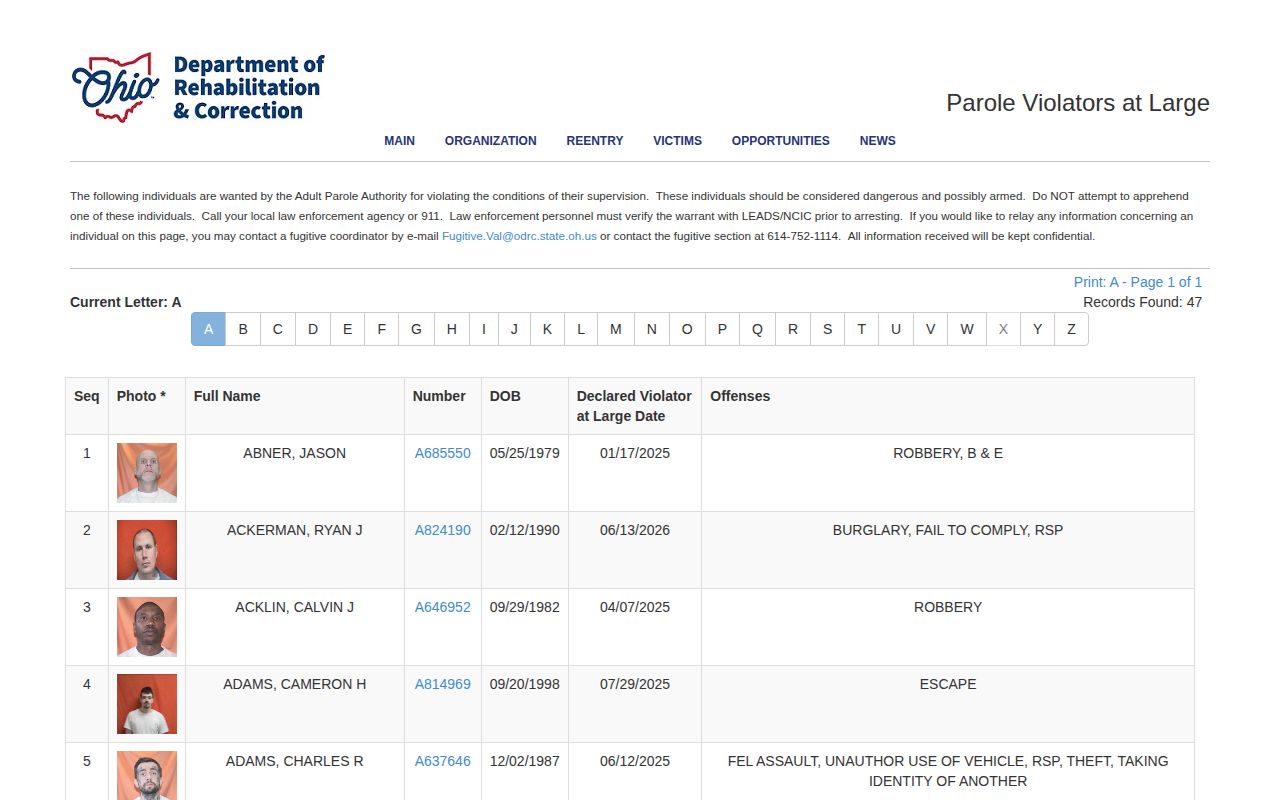
ODRC maintains an official Parole Violators at Large list, commonly called PVAL. It can display a photo, name, offender number, birth date, declared-at-large date, and offenses. A match is evidence of release to supervision followed by alleged absconding. It is not reliable proof of a current location.
The agency expressly tells the public not to apprehend anyone. Law enforcement must verify a warrant through LEADS or NCIC before acting. Tips may be sent to Fugitive.Val@odrc.state.oh.us or 614-752-1114. A later warrant does not erase the truth of an earlier release. It is a new event that must be read with the historical custody record.
The official ODRC PVAL page shows both the public fields and the verification warning.
Allen Supervision Terms and Violations
Conditions vary by the controlling order. They may require reporting, approved travel, program participation, or other conduct stated by the court or APA. Public pages should not guess at a person's terms. Read the journal entry or public ODRC fields, then seek the public order from the proper custodian.
An alleged violation can lead to a hearing, changed conditions, a warrant, a return to custody, or no final adverse finding. A docket entry or PVAL listing should be reported in its own terms. It does not prove the outcome of a later proceeding. Ohio Revised Code Chapter 5149 describes APA organization and duties, while ORC 2967.28 governs post-release control. Those laws do not replace the individual order.
VINELink reports custody events supplied by participating agencies. It may help track a return to jail or prison, but it does not function as an APA case file. Confirm a custody alert with ODRC, the sheriff, and the court as the event requires.
Read Allen Probation Court Records
Allen County has a meaningful court split. Common Pleas holds felony cases and county probation matters. Lima Municipal Court holds cases within its municipal jurisdiction. Start with the case number when known, since a name search can return several people or several proceedings for one person. Read the chronological docket and open the filed journal entries around sentencing, alleged violations, modification, and termination.
A jail record and a probation record describe different stages. Bond or recognizance may explain why someone left jail while the criminal case continues. A community-control entry establishes the court supervision that follows. A later violation allegation is not the same as a final finding. The filed ruling shows whether the judge continued, changed, revoked, or ended supervision.
The sheriff's arrest-history response does not supply final disposition. The Records Bureau directs that question to the court that heard or dismissed the case. For that reason, a supervision check should never stop at the Allen jail release timestamp.
Confirm Allen Supervision Discharge
Supervision ends through a formal discharge, expiration, or authorized early termination. In ODRC detail, Expiration of Supervision Term is the maximum endpoint. Supervision End Date or Early Termination is stronger evidence that supervision actually ended when the field is populated. A completed end date does not erase the prior case or custody record.
For probation, use the sentencing court. Search for a termination or final-discharge journal entry and make sure it belongs to the same case. The Lima Municipal Court 2025 annual report counted 269 successful and 50 unsuccessful probation terminations. Those totals describe local supervision exits, but they cannot identify a person and are not jail-release statistics. A direct docket entry is the useful evidence.
Record the date each source was checked. If the court and supervision system disagree, the court is primary for its order while the supervising agency is primary for present operational status. Preserve both timestamps and ask the owning office to reconcile the difference. A completed term also does not mean the case has been sealed. Sealing or expungement requires its own court process under Ohio law.
Public Record Search
Sponsored Results