
AOCI State Release Paths
Allen-Oakwood Correctional Institution is an Ohio state prison operated by the Ohio Department of Rehabilitation and Correction. It is not the Allen County jail. People at AOCI are serving state sentences, and the statewide offender record follows them even if another county committed them. Release can mean parole, post-release control, judicial release, transitional control, sentence expiration, or full discharge. It may also mean a transfer to another ODRC institution, which is not release from prison custody.
AOCI's Lima address does not establish where a person will live after departure or which court imposed the sentence. The committing county, docket, judge, offenses, aggregate term, and state status all help identify the governing record. A person can leave incarceration under Adult Parole Authority supervision. Another may reach sentence expiration with no further ODRC supervision. A judicial release depends on the sentencing court's order. Each route calls for a different final check.
Confirm an AOCI Release
Use the official ODRC Offender Search. An offender number is the strongest key. Ohio numbers use an A, R, or W prefix with six digits, while an older five-digit women's number requires a leading zero. If the number is unknown, search by surname and first name, then compare identifiers and sentence data rather than relying on the name alone.
- Search the offender number, or begin with a broad name search.
- Run separate searches for Incarcerated, Released, and APA Supervision status.
- Open the matching detail and compare birth data, committing county, docket, offenses, and institution history.
- Read Parole or Release Detail and supervision fields, not merely the expected date.
- Check the sentencing docket when judicial release or another court order appears.
County of Commitment means the sentencing county and may query only the first listed county when several counties are involved. It does not identify all people housed at AOCI. Residential County works with APA Supervision or Violators at Large searches and may lag. The Allen County released inmates search overview explains when a county jail record belongs in the verification chain instead.
Read AOCI Release Fields
ODRC detail may include a correctional photo, offender number, admission, institution history, offenses, sentence components, jail-time credit, committing county, docket, judge, and release or supervision information. Not every field appears on every record. ODRC also warns that sentence information can be incomplete. Treat fields as parts of one state record, and reconcile important dates with the court when needed.
| ODRC field | Meaning for AOCI release |
|---|---|
| Status: Incarcerated | The person remains in ODRC prison custody, even if a future date is shown. |
| APA Supervision | The person has left incarceration under Department supervision. |
| Released | A release or discharge history exists; read the detailed event. |
| Judicial Release | The sentencing court authorized early release under Ohio law. |
| Parole or Release Detail | Documents the state release or parole event when populated. |
| Supervision End Date | Can document the actual end of state supervision when completed. |
An institution name can remain in the historical part of a record after status changes. That does not mean a person under supervision still lives inside AOCI. Likewise, a released status does not prove that all court or supervision obligations ended. Read the record as of the check date and keep the offender number with any notes.
AOCI Expected Date Limits
ODRC labels the key prospective field “Expected Release Date/Parole Eligibility Date.” The combined label is deliberate. It can be a projected departure date or a date tied to parole consideration. PRD means Projected Release Date. POA means parole on or after. Neither term alone proves that a person passed through the gate.
A granted hearing outcome or POA date can precede actual departure. Credits, hearing action, a hold, sentence recalculation, and other legal events may change what happens. “Earliest Possible Transfer Date” concerns potential transitional control, not unconditional community release. Transitional control is a form of custody that can involve a halfway-house phase. “TC/TT Sentence Expiration” concerns that community-confinement period. Confirm that status changed out of incarceration and that release detail was populated.
Note: A future ODRC date is a planning field, while status and release detail document the later custody event.
AOCI Records and Contact
The official AOCI facility page identifies the institution at 2338 North West Street, Lima, Ohio 45801. The main telephone is 419-224-8000. Official state materials also list P.O. Box 4501, Lima, OH 45802 for mail. Contact the institution for current facility routing, but use ODRC Central Records for a formal state correctional record request.
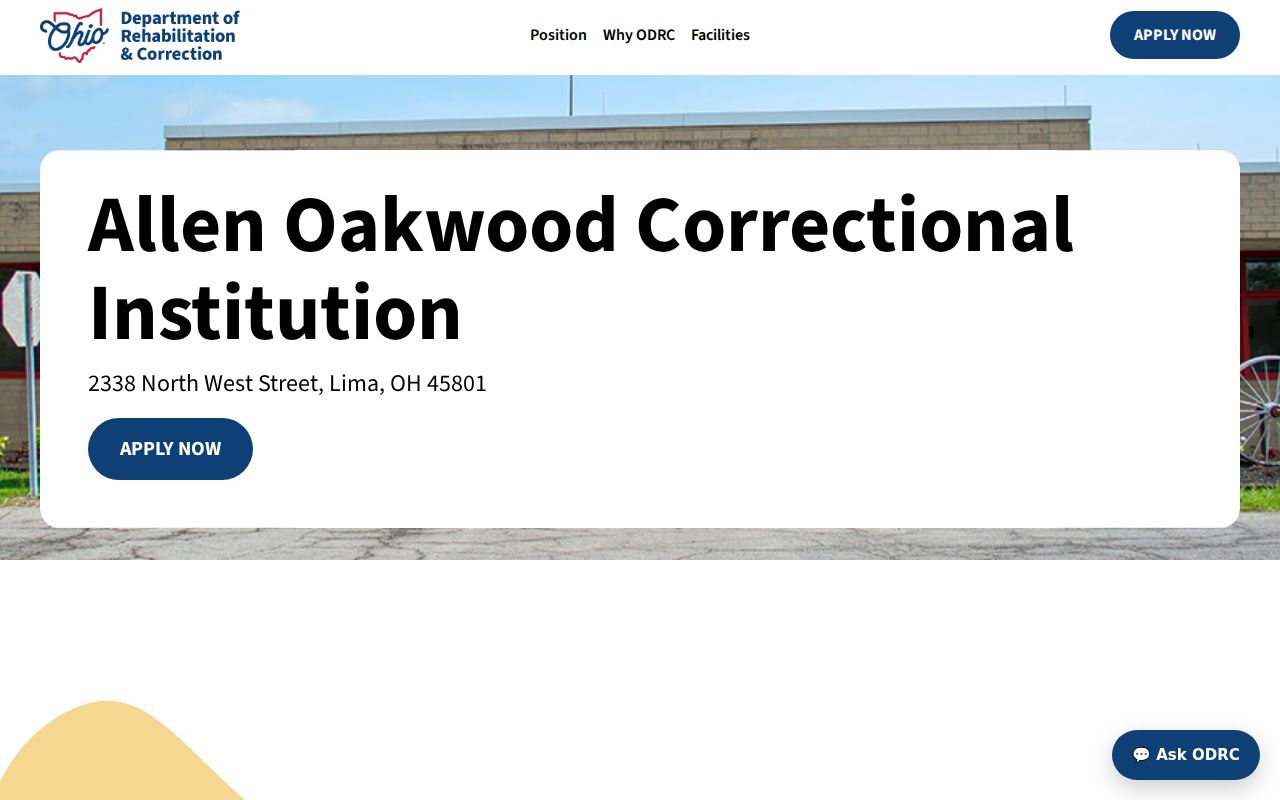
The state facility capture confirms AOCI's institutional identity; offender status and release detail still come from the separate statewide ODRC search.
2338 North West Street
Lima, OH 45801
Main: 419-224-8000
Mail: P.O. Box 4501, Lima, OH 45802
Write ODRC Central Records, P.O. Box 430, Columbus, OH 43216. Include the offender's name and number, committing county, relevant date range, and the exact release, parole, status-history, or correctional-photo record sought. OAC 5120-9-49 governs inspection and copying. For a parole board determination or minutes, identify the hearing date. A county booking photo request does not belong with ODRC because the prison photo and county jail image are distinct records.
AOCI Supervision After Release
APA Supervision means the person has left prison but remains under ODRC supervision. The detail can show a supervision start, period, assigned APA office, conditions, maximum expiration, and an actual end or early termination when populated. The office shown in the state record is the sound routing point. Do not assume that Allen County probation supervises the case simply because AOCI is in Lima.
Parole is conditional release for a person whose sentence falls within that system. Post-release control is a statutory period of supervision after prison for covered offenses. Probation, also called community control in Ohio courts, is imposed and managed through the sentencing court rather than the prison. A completed supervision end field is stronger evidence of discharge from APA supervision, but it does not erase the conviction or prison history.
- Parole
- Conditional release from prison under APA oversight.
- Post-release control
- State supervision following prison for covered sentences.
- Judicial release
- Early release authorized by the sentencing court.
- Discharge
- The end of the identified prison or supervision obligation.
AOCI Court Record Check
The sentencing docket supplies the judgment behind imprisonment and judicial release. ODRC's County of Commitment can point toward that court, though multiple committing counties require care. Read the docket for sentencing, jail-time credit, later modification, judicial release, and supervision entries. The state record remains primary for physical ODRC status, while the court is primary for the legal order.
When sources disagree, preserve both check times. A court may issue an order before prison processing changes the public status. Do not replace ODRC's live incarceration status with a date calculated from the sentence. Send a genuine field dispute to Central Records with the offender number, committing county, exact field, and a certified journal entry or other authoritative support.
About Allen-Oakwood Records
AOCI is one of the verified operating correctional institutions in Allen County. Historical references to Lima Correctional Institution must not be treated as a current prison. The Allen-Oakwood name and address should be matched against the state record. Its presence in the county creates two separate questions: which system held the person, and which jurisdiction imposed the sentence.
No official source reviewed supplied an AOCI-only public release roster. ODRC's statewide system is the public search path. It covers incarcerated people, released records, judicial releases, APA supervision, and violators at large. A name absent from one status filter should be checked under the other relevant state statuses, using fewer criteria if an over-constrained query fails. Record the check date and each status searched. Open the matching detail rather than treating the brief results row as a complete release record.
Federal and immigration systems are separate again. A person no longer in ODRC custody could enter another sovereign's custody. The BOP locator, ICE locator, and relevant court record apply only when facts support that path. “Not in ODRC custody” should not be expanded into “not in any custody.”