
Allen Scheduled and Actual Release
A scheduled date is prospective. It may reflect a sentence calculation, a parole-eligibility date, or a date that remains subject to agency action. Actual release is historical. For an Allen County jail booking, the sheriff inquiry can show an Actual Release Date after custody ends. For an Ohio prison case, ODRC status must move out of incarcerated and the Parole or Release Detail should support the event.
ODRC labels its public field Expected Release Date/Parole Eligibility Date. That label deliberately combines two different ideas. A projected date estimates release. A parole-eligibility date marks when consideration may occur. The record may also show POA/PRD Date. POA means parole on or after, and PRD means projected release date. None is a promised exit appointment.
A pretrial detainee has no sentence-based endpoint. Bond may be posted, a court may change the order, or another agency may lodge a hold. Even a county-sentenced person needs the jail's current calculation. No public Allen-specific jail good-time formula was verified.
Locate an Allen Projected Date
Choose the route by custody class. The ODRC Offender Search applies to a sentenced state prisoner, including someone at Allen-Oakwood Correctional Institution. The Allen sheriff inquiry and sentencing court records apply to a county-jail term. A person who merely left the county jail for ODRC was transferred, not released into the community.
- Identify whether the person is pretrial, serving a county sentence, or serving an ODRC term.
- For ODRC, search by offender number when known, then match name, birth data, and County of Commitment.
- Read status, sentence entries, Expected Release Date/Parole Eligibility Date, POA/PRD, hearing result, and Parole or Release Detail together.
- For county custody, read the sentencing journal entry and jail-time credit, then ask prisoner information or sheriff records for the current calculated date.
- Recheck after any court entry, disciplinary credit action, detainer, parole decision, or custody transfer.
County of Commitment=Allen identifies the first listed sentencing county. It does not find everyone housed at AOCI. If extra search fields produce no result, use fewer criteria and verify identifiers. The Allen County release-search path helps distinguish local, state, federal, and immigration custody.
Ohio Credits in Allen Sentences
A simplified state calculation begins with the journalized term. Consecutive terms are combined as law requires. Jail-time credit is then applied under ORC 2967.191. Mandatory or non-credit-eligible portions must be identified before any earned credit is considered. The agency, not a public arithmetic shortcut, makes the operative calculation.
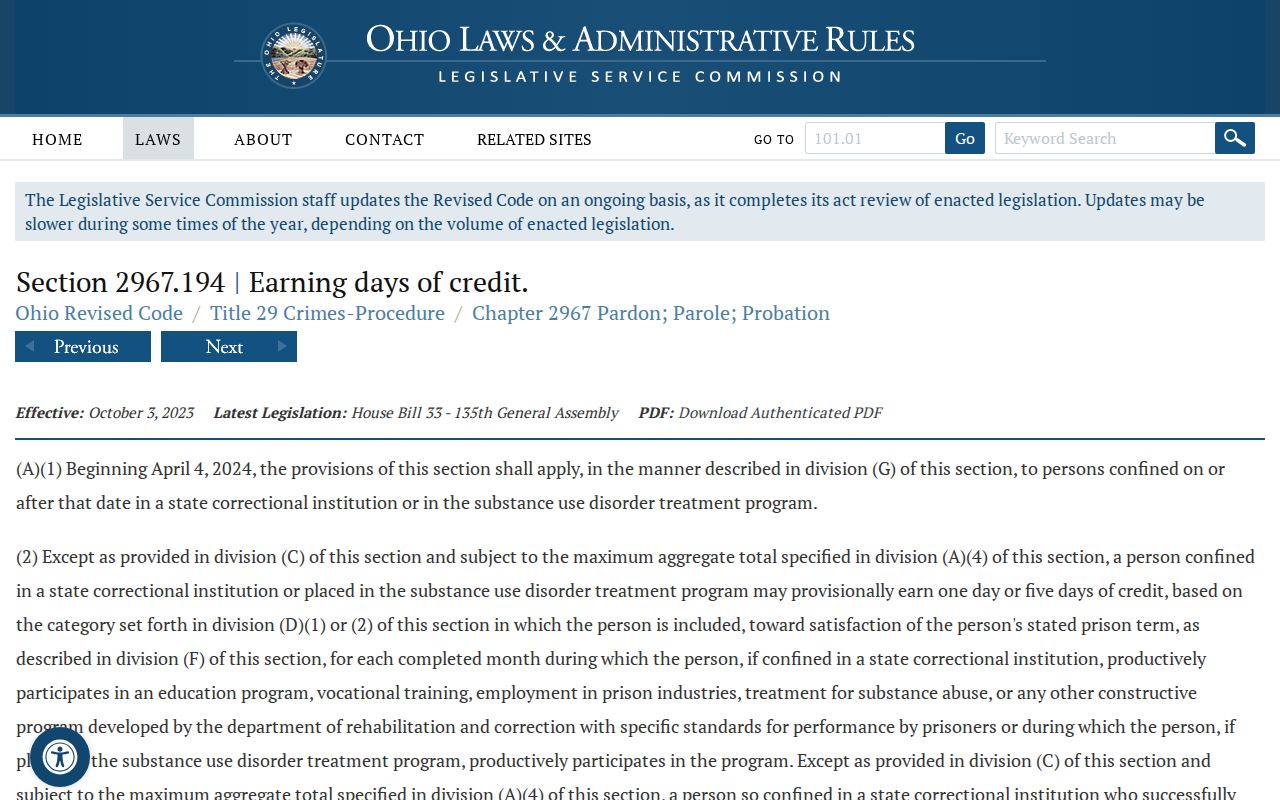
For confinement on or after April 4, 2024, ORC 2967.194 allows provisional monthly credits, generally one or five days based on the qualifying activity category, plus certain completion credits. Ordinary participation and completion credits under division (A)(2) are capped at 15 percent of the stated term. Credits may be denied or withdrawn for misconduct and become final only after administrative review. Listed terms and offenses are excluded.
The current Ohio earned-credit statute supplies the controlling categories, caps, and exclusions.
No Universal Allen 85 Percent Rule
Ohio does not promise that every person serves exactly 85 percent. The 15 percent ordinary-credit ceiling can resemble an 85 percent arithmetic floor for an otherwise eligible definite term. That shorthand fails when the sentence has mandatory time, an excluded offense, different sentence dates, special completion awards, lost credit, parole review, or an indefinite term.
This is the distinctive Allen projected-release-date problem reflected in ODRC's combined label. A date may be a projected release or only pending parole consideration. Read the hearing result and POA/PRD field. A parole grant or POA date can still precede actual departure. ODRC status and release detail remain the final public check.
Historical ORC 2967.193 applied before the current law's effective date. It should not be treated as the sole current rule for every person. Sentence date and statutory eligibility matter.
Allen Indefinite Terms and Parole
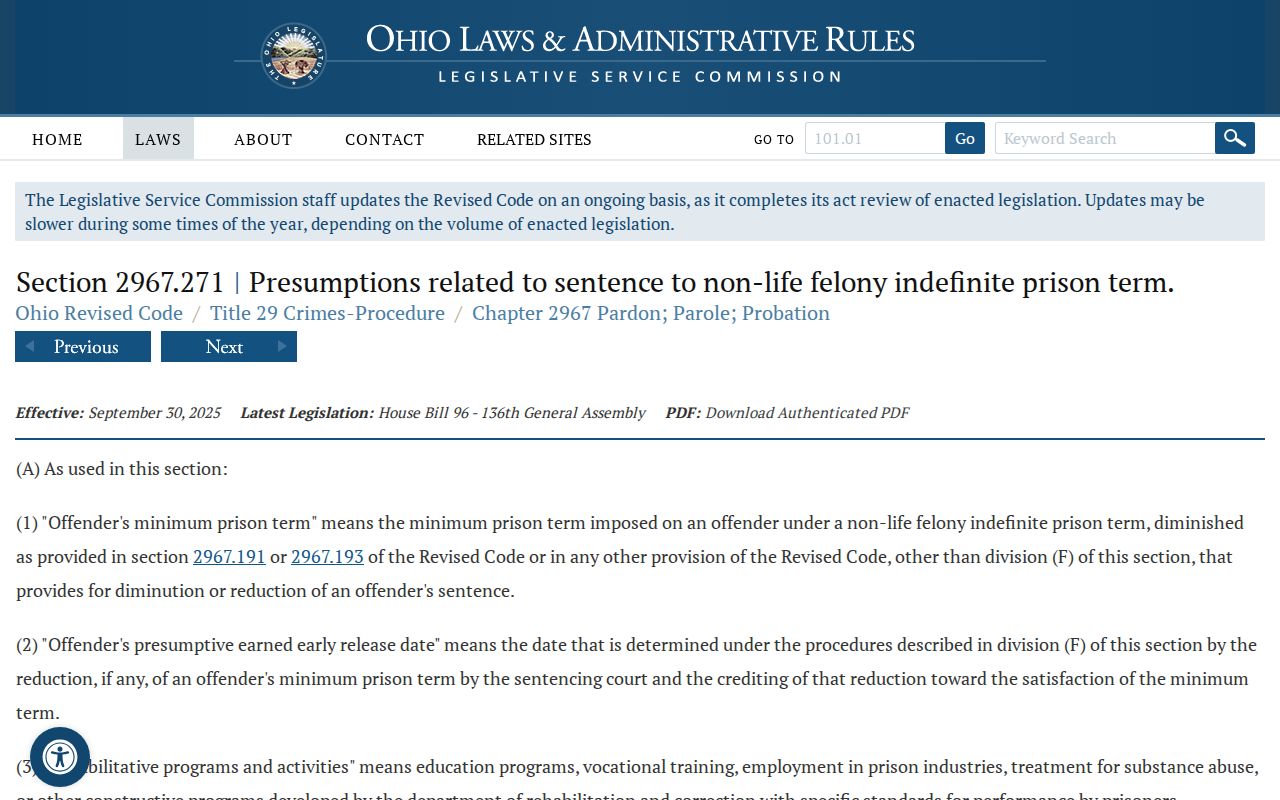
Parole-eligible life terms follow ORC 2967.13. Eligibility permits consideration; it does not require release. Reagan Tokes non-life indefinite terms have a minimum and maximum framework under ORC 2967.271. The law provides a presumptive-release process and permits a hearing that may affect continued confinement.
The official indefinite-term statute shows the presumption and hearing structure.
Transitional control under ORC 2967.26 is another source of confusion. It can move a person to a halfway-house form of custody before sentence expiration. ODRC may show an Earliest Possible Transfer Date and TC/TT Sentence Expiration. The first is a possible custody transfer, not full discharge into the community.
What Changes Allen Release Dates
Dates can move for reasons found in the legal or custody record. The direction and size of a change cannot be guessed without the updated calculation.
| Factor | Record to check | Possible effect |
|---|---|---|
| Jail-time credit | Court journal entry and ODRC calculation | Qualifying prior confinement reduces time |
| Earned credit or misconduct | ODRC sentence and credit record | Award, denial, or withdrawal changes projection |
| Concurrent or consecutive correction | Filed sentencing or appellate entry | Changes how terms combine |
| Detainer or hold | Custody and receiving-agency record | May prevent community departure |
| Parole decision | Hearing result and POA/PRD | Grant, denial, or continuance changes timing |
| Judicial release | Sentencing-court order and ODRC status | Can authorize earlier prison release |
| Transitional control | ODRC transfer fields | Changes custody setting, not sentence discharge |
A date that passed while status remains incarcerated is not proof that the agency erred. The field may have represented parole review, credit may have changed, or an indefinite-term hearing may have continued confinement. If the record truly conflicts with a certified order, contact ODRC Central Records at P.O. Box 430, Columbus, OH 43216, with the offender number and exact disputed field.
Allen County Jail Date Limits
A county-jail sentence does not use the public ODRC projected-date field. Begin with the sentencing journal entry, including the term and any jail-time credit. Then ask Allen County prisoner information or sheriff records for the current calculation. The inquiry's Scheduled Release Date is prospective, while Actual Release Date documents the completed booking event.
No Allen-specific public good-time formula was verified. Generic Ohio arithmetic cannot safely supply the missing date. Ask whether the quoted date includes jail-time credit, other holds, and any local weekend or holiday procedure. No source established an ordinary release time, release-door location, or automatic calendar adjustment, so those details must come from the jail for the specific case.
Bond release follows a different path. It depends on bond eligibility, posting, court authority, other holds, and processing. It is not computed through sentence credit. The sheriff states that eligible bonds can be posted around the clock, but that does not promise an immediate exit or a future release time.
A pretrial case can also change quickly. A new bond order, dismissal, plea, sentence, warrant, or detainer may replace the premise behind an earlier estimate. Read the latest signed journal entry, then confirm that the jail processed it. Court authorization and physical release may carry different timestamps without either record being wrong.
Confirm an Allen Actual Release
For a state prisoner, recheck ODRC after the anticipated date. A Released, APA Supervision, or Judicial Release status has a different meaning from Incarcerated. Read Parole or Release Detail and the supervision fields. An institution name may remain in a historical record even after status changes, so status controls the present interpretation.
For a county booking, clear In Custody in the sheriff inquiry and open the matching detail. Read Actual Release Date, not merely Scheduled Release Date. Compare the bond or charge disposition with the correct Common Pleas or Lima Municipal docket. A transfer to ODRC, another jail, federal custody, or immigration custody ends Allen jail custody without proving community release.
Ohio VINE can send a custody-event alert. The VINELink Release Check explains the one-person search and notification steps. Treat the alert as corroboration and confirm the event with the jail or ODRC record. A VINE notice may report release or movement without explaining the legal basis, so retain the event time and reporting facility.
When official sources conflict, record when each was checked. The court controls the legal order; the jail or ODRC controls its operational custody status. Both timestamps can be valid when authorization came before physical processing. Ask the direct custodian to correct a genuine field error rather than replacing the agency date with a private calculation.
Public Record Search
Sponsored Results